Chapter 1 - Arc of Life Learning
Quote: “Furthermore, everything - and everyone - around us can be seen as resources for learning.” (Thomas, 2011, p.32) I chose this quote because this is how they define the new culture of learning. You aren’t only learning through books and from teachers. You are learning from others online and information is constantly evolving.
Question: Learning from others on online forums is the new culture of learning, but how do we ask parents to allow their children to talk to strangers online?
Connection: Through this master’s program I am constantly searching online for information to help me with certain topics, especially for my EDL600 class. Some of the topics are so complex and dense that looking up additional information allows me to make sense of it and piece it together. I’m no longer only learning from a textbook, but I’m going online and looking at other sources and learning from my peers. Learning is much more collaborative than it used to be. I depend on others for help.
Epiphany/Aha: I can’t wait to give my students the opportunity to discover this new culture of learning. I want to watch them succeed in finding information without my help either by researching online or getting feedback from others.
Chapter 2 - A Tale of Two Cultures
Quote: “Unlike the traditional sense of culture, which strives for stability and adapts to changes in its environment only when forced, this emerging culture responds to its surrounding organically. It does not adapt. Rather, it thrives on change…” (Thomas, 2011,p.37). I chose this quote because this is how the new culture of learning will look in a classroom. You do not know which way the learning will take you, it is a constantly changing path. Students will learn from how they achieve their goal, not just by reaching it.
Question: How do we do a complete 180 degree turn from a mechanistic approach to this new culture of learning? What are the baby steps in between these two drastic methods?
Connection: When state testing is over and the pressure to teach all the necessary material is relieved, I feel like I’m finally able to create a classroom environment that is similar to this new culture of learning. I allow the students to research ideas they are interested in. I allow them time to look up art projects they are interested in and it creates a classroom culture that is so interesting. I need to allow time throughout the year to do these types of projects, but feel pressured to get through so much material that I lose track of time.
Epiphany/Aha: The comparison between the new culture of learning and a science experiment was an epiphany moment for me. You have “very limited foreknowledge of what will result” (Thomas, 2011,p.37), and you are interested in the process, not the result of the experiment. This is how it should be in the classroom. We should help the students cultivate their learning, and not know the outcome because it isn’t the product that is valued, it’s the process of getting there.
Chapter 3 - Embracing Change
Quote: “As information is constantly produced, consumed, updated, and altered, new practices of reading, writing thinking and learning have evolved with it” (Thomas, 2011, p.42). I chose this quote because this is what we need to communicate about school if we are questioned about why we’re teaching differently. We’re teaching differently because information is constantly changing so we need to embrace the change and learn differently as well.
Question: I remember being told by professors in college that Wikipedia was not a credible source to use in papers. Is this still the case or have people started realizing Wikipedia is as credible as Encyclopedia Britannica?
Connection: This chapter reminds me of the SAMR model. Many of my colleagues are using technology in their classrooms everyday but they’re only using it to replace what they’d already been doing with traditional teaching (This is “S” in SAMR called Substitution). We need to not only use technology, but change our teaching as well to embrace the change in learning. Students should perform tasks that can be done on a computer, but can only be done on the computer. For example students can write a story, record themselves reading it aloud and draw pictures to create a presentation to share with their peers. This can only be done using technology.
Epiphany/Aha: The history of the advancement of the television compared to the internet was amazing! No wonder education didn’t change for so long; technology hadn’t either. Seventy years from the beginning of color tv to it being common in households compared to ten years from the beginning of the internet to it being common in households! Why is nobody talking about this type of change at schools? I feel like this is a huge aha moment!
Resources
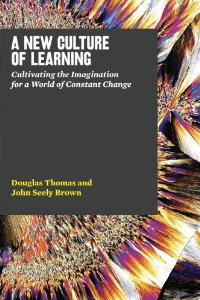
Thomas, D., & Brown, J. (2011). A new culture of learning: Cultivating the imagination for a
world of constant change. Lexington, KY: CreateSpace Independent Publishing
Platform.
Quote: “Furthermore, everything - and everyone - around us can be seen as resources for learning.” (Thomas, 2011, p.32) I chose this quote because this is how they define the new culture of learning. You aren’t only learning through books and from teachers. You are learning from others online and information is constantly evolving.
Question: Learning from others on online forums is the new culture of learning, but how do we ask parents to allow their children to talk to strangers online?
Connection: Through this master’s program I am constantly searching online for information to help me with certain topics, especially for my EDL600 class. Some of the topics are so complex and dense that looking up additional information allows me to make sense of it and piece it together. I’m no longer only learning from a textbook, but I’m going online and looking at other sources and learning from my peers. Learning is much more collaborative than it used to be. I depend on others for help.
Epiphany/Aha: I can’t wait to give my students the opportunity to discover this new culture of learning. I want to watch them succeed in finding information without my help either by researching online or getting feedback from others.
Chapter 2 - A Tale of Two Cultures
Quote: “Unlike the traditional sense of culture, which strives for stability and adapts to changes in its environment only when forced, this emerging culture responds to its surrounding organically. It does not adapt. Rather, it thrives on change…” (Thomas, 2011,p.37). I chose this quote because this is how the new culture of learning will look in a classroom. You do not know which way the learning will take you, it is a constantly changing path. Students will learn from how they achieve their goal, not just by reaching it.
Question: How do we do a complete 180 degree turn from a mechanistic approach to this new culture of learning? What are the baby steps in between these two drastic methods?
Connection: When state testing is over and the pressure to teach all the necessary material is relieved, I feel like I’m finally able to create a classroom environment that is similar to this new culture of learning. I allow the students to research ideas they are interested in. I allow them time to look up art projects they are interested in and it creates a classroom culture that is so interesting. I need to allow time throughout the year to do these types of projects, but feel pressured to get through so much material that I lose track of time.
Epiphany/Aha: The comparison between the new culture of learning and a science experiment was an epiphany moment for me. You have “very limited foreknowledge of what will result” (Thomas, 2011,p.37), and you are interested in the process, not the result of the experiment. This is how it should be in the classroom. We should help the students cultivate their learning, and not know the outcome because it isn’t the product that is valued, it’s the process of getting there.
Chapter 3 - Embracing Change
Quote: “As information is constantly produced, consumed, updated, and altered, new practices of reading, writing thinking and learning have evolved with it” (Thomas, 2011, p.42). I chose this quote because this is what we need to communicate about school if we are questioned about why we’re teaching differently. We’re teaching differently because information is constantly changing so we need to embrace the change and learn differently as well.
Question: I remember being told by professors in college that Wikipedia was not a credible source to use in papers. Is this still the case or have people started realizing Wikipedia is as credible as Encyclopedia Britannica?
Connection: This chapter reminds me of the SAMR model. Many of my colleagues are using technology in their classrooms everyday but they’re only using it to replace what they’d already been doing with traditional teaching (This is “S” in SAMR called Substitution). We need to not only use technology, but change our teaching as well to embrace the change in learning. Students should perform tasks that can be done on a computer, but can only be done on the computer. For example students can write a story, record themselves reading it aloud and draw pictures to create a presentation to share with their peers. This can only be done using technology.
Epiphany/Aha: The history of the advancement of the television compared to the internet was amazing! No wonder education didn’t change for so long; technology hadn’t either. Seventy years from the beginning of color tv to it being common in households compared to ten years from the beginning of the internet to it being common in households! Why is nobody talking about this type of change at schools? I feel like this is a huge aha moment!
Resources
Thomas, D., & Brown, J. (2011). A new culture of learning: Cultivating the imagination for a
world of constant change. Lexington, KY: CreateSpace Independent Publishing
Platform.